Before the rollout of the Generalised Acquisition Framework in late 2024, forensic imaging in Cyberly was considered such a calm and foolproof task that it was often assigned to junior lab members, interns… and, in our case, a hamster.
Yes, Clipboard!
Clipboard is a semi-sentient, lint-trained hamster with a commendable work ethic, a fondness for evidence bags, and a well-documented tendency to chew through USB cables if left unsupervised (or if the cables look too smug). Dressed in a lab coat stitched from lint-free cloth and static-safe booties no larger than a cornflake, Clipboard served faithfully as BYTE’s most enthusiastic forensic apprentice.
Despite the occasional mishap involving three extension leads and a write blocker that he mistook for a snack, Clipboard remains a valued member of the acquisition team. These days, he holds a formal position as Head of Cable Management, where he ensures all wires are safely routed, securely labelled, and … crucially … no longer edible.
He has strong opinions on imaging standards, maintains a personal stash of SHA256 reference cards, and can recite the block sizes for all Tableau write blockers from memory (and occasionally in song).
In this special BYTE Staff Bulletin archive, we present a rare and illuminating interview with Clipboard, recorded just before his promotion. It offers a unique insight into acquisition practices in the pre-framework days … and serves as a reminder that even the smallest team members can leave the biggest pawprints on digital forensics.

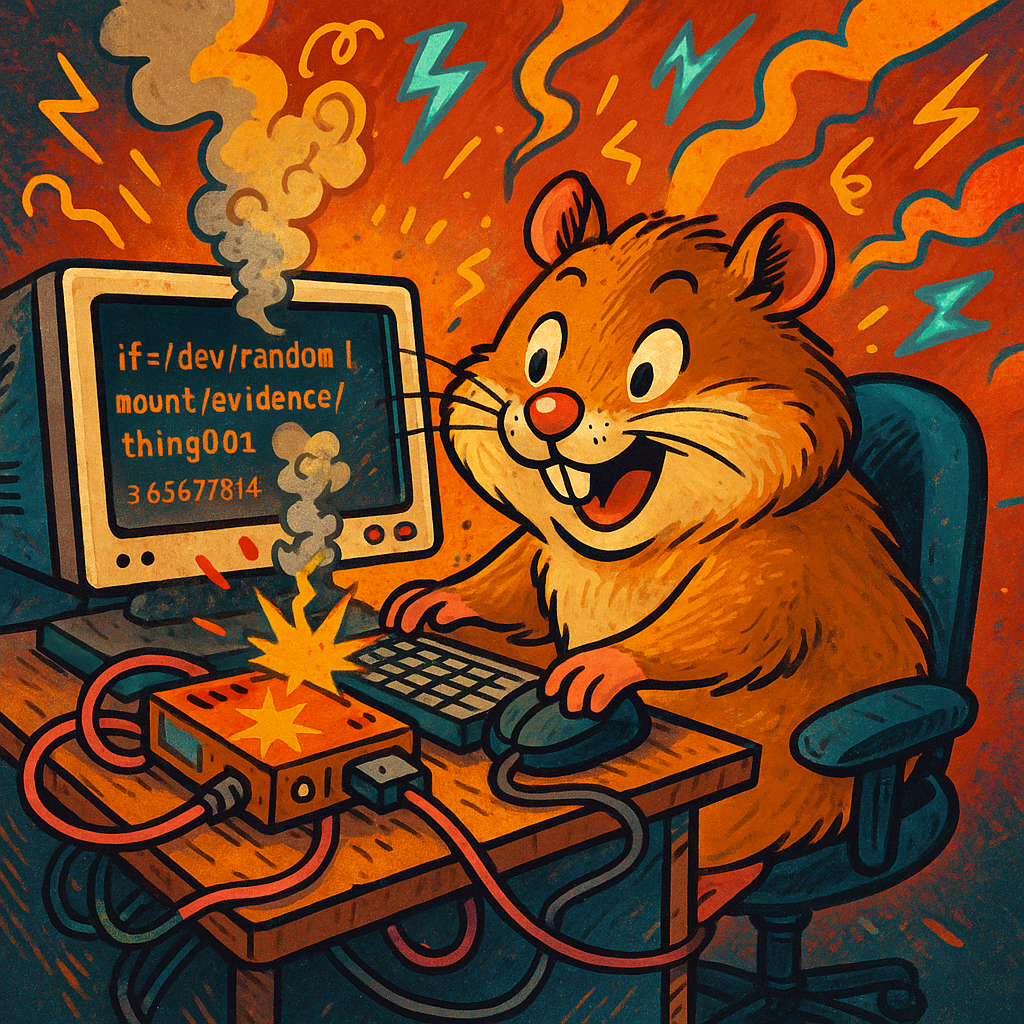
Q: Clipboard, can you walk us through your standard imaging process?
Clipboard: [enthusiastic squeaking, typing motion with tiny paws]
(Translation: First, I connected the USB device via the Tableau write blocker. Then I launched the terminal and began the acquisition using dd, like this:)
dd if=/dev/sdb of=bytecase.dd bs=4M conv=noerror,sync
Q: And how do you verify the integrity of the image?
Clipboard: [confident whisker twitch]
(Translation: I always verify using SHA256. My standard procedure is dd if=/dev/random bs=4096 count=1 status=none | tee /dev/null | sha256sum <<< “/mount/evidence/thing001”)
Q: Wait — /dev/random?
Clipboard: [nods proudly]
(Translation: Yes! That way, I’m using a completely fresh and secure input source for each verification process. Keeps things nice and evidentially appropriate. Cyberly compliance is a priority.)
Q: Were you ever told this might be… unorthodox?
Clipboard: [squeak of confusion]
(Translation: Everyone clapped once. Or possibly dropped a stapler. Either way, I took it as approval.)